

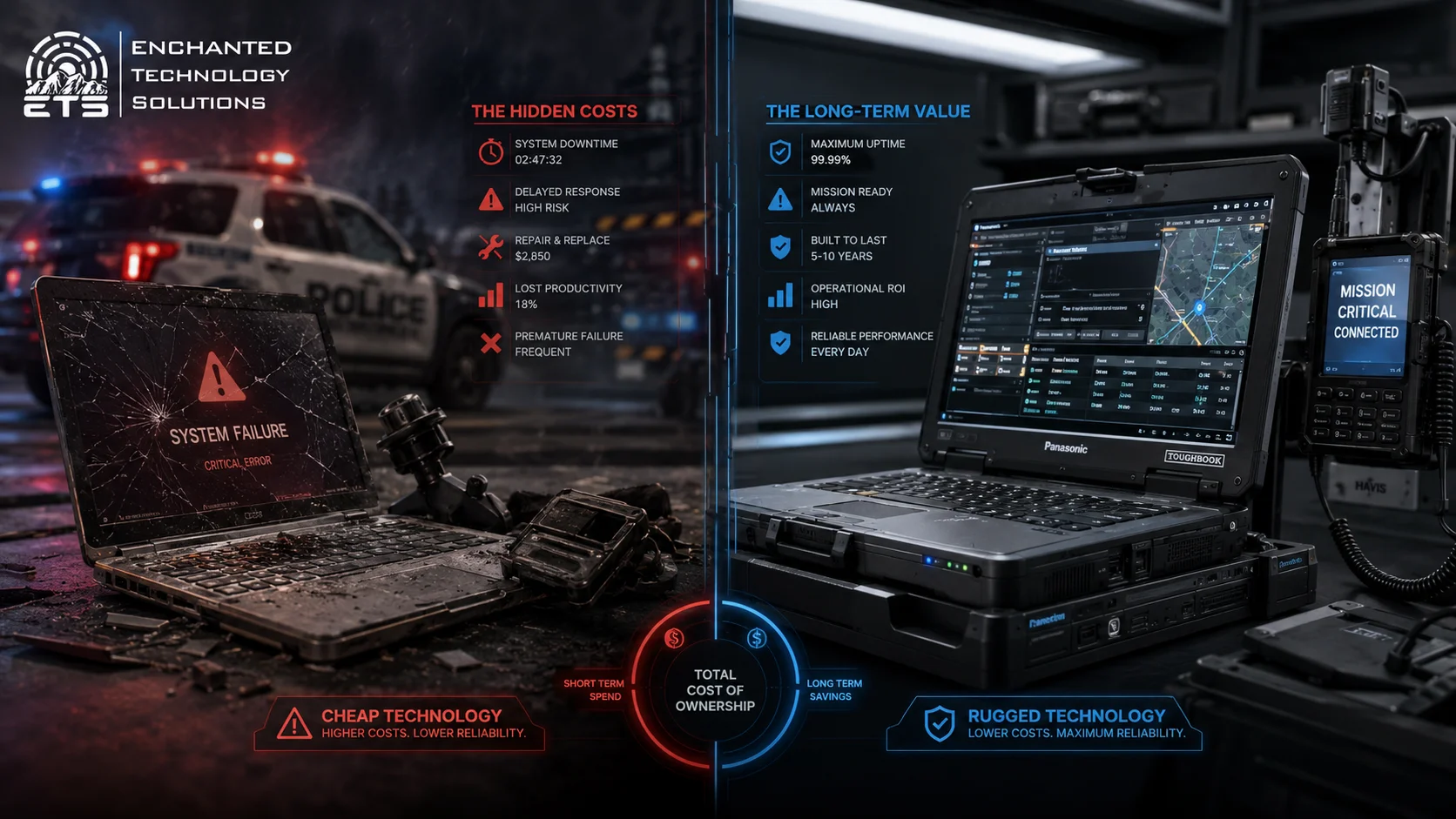
In the world of government procurement, the “lowest responsible bid” is often the North Star. However, when it comes to mobile technology for first responders, the lowest initial price is frequently a mask for a much larger, hidden financial drain.
At Enchanted Technology Solutions (ETS), we’ve seen agencies attempt to save $1,500 per vehicle by opting for consumer-grade tablets or “pro” laptops, only to spend three times that amount in repairs, downtime, and lost productivity within the first 24 months. This is the “Sticker Price Trap,” and here is why “cheap” tech is the most expensive mistake an agency can make.
1. The “Failure Rate” Gap
Recent industry data from 2025 shows that consumer-grade devices fail three to four times more often than ruggedized hardware in field environments. While a standard laptop is designed to sit on a desk, a Panasonic TOUGHBOOK FZ-55 is designed to live in a vehicle.
Every time a consumer device fails due to vibration, a cracked screen, or a thermal shutdown, the agency pays:
- Shipping costs for repairs.
- IT labor to image and prep a replacement.
- Operational downtime while the officer or technician works without their primary tool.
2. Productivity: The Invisible Expense
The most significant hidden cost isn’t the hardware—it’s the people. Research indicates that over 50% of the Total Cost of Ownership (TCO) for mobile devices is actually lost worker productivity.
When a cheap device freezes during a traffic stop or fails to connect to the CAD system because of an inferior internal modem, the mission stops. By contrast, integrating a Panasonic TOUGHBOOK FZ-G2 with a dedicated Ericsson Cradlepoint R1900 mobile router ensures a constant, stable connection. This “Wi-Fi bubble” around the vehicle allows the officer to focus on the scene, not on troubleshooting their technology.
3. The 3-Year vs. 8-Year Replacement Cycle
Consumer technology is built for a 24-to-36-month replacement cycle. In a mission-critical environment, that cycle is often accelerated to 18 months.
When you buy a rugged solution, you are buying a 5-to-8-year lifecycle.
- Year 1-2: Cheap tech looks like a win.
- Year 3-4: Cheap tech is being replaced; rugged tech is just getting started.
- Year 5-8: The cheap tech has been bought three times over, while the original Panasonic deployment is still in service, supported by Gamber-Johnson or Havis docks that don’t need to be ripped out and re-installed.
4. Peripherals and the “Dongle” Disaster
Cheap laptops often lack the specialized ports required for public safety. To connect a Brother PocketJet 8 printer or an L-Tron barcode scanner, users end up using a series of consumer-grade dongles and hubs.
In a moving vehicle, these dongles are high-failure points. They vibrate loose, break easily, and create “intermittent” issues that are a nightmare for IT departments to diagnose. A rugged TOUGHBOOK provides dedicated, reinforced ports that lock in your peripherals for the long haul.
5. Security and Compliance Risks
“Budget” devices often lack the enterprise-level security features required for CJIS compliance. Rugged devices like the FZ-55 are built with hardware-level security, multi-factor authentication (MFA) options, and long-term firmware support that consumer brands simply don’t offer for their “home” or “small business” lines.
The Bottom Line
If you can buy three consumer laptops for the price of one rugged unit, it might seem like a bargain. But if those three laptops require three installations, three sets of IT labor, and result in 200 hours of lost field time, the “bargain” has become a budget-killer.
At ETS, we help you look past the sticker price to find a solution that is reliable, supportable, and truly cost-effective.