

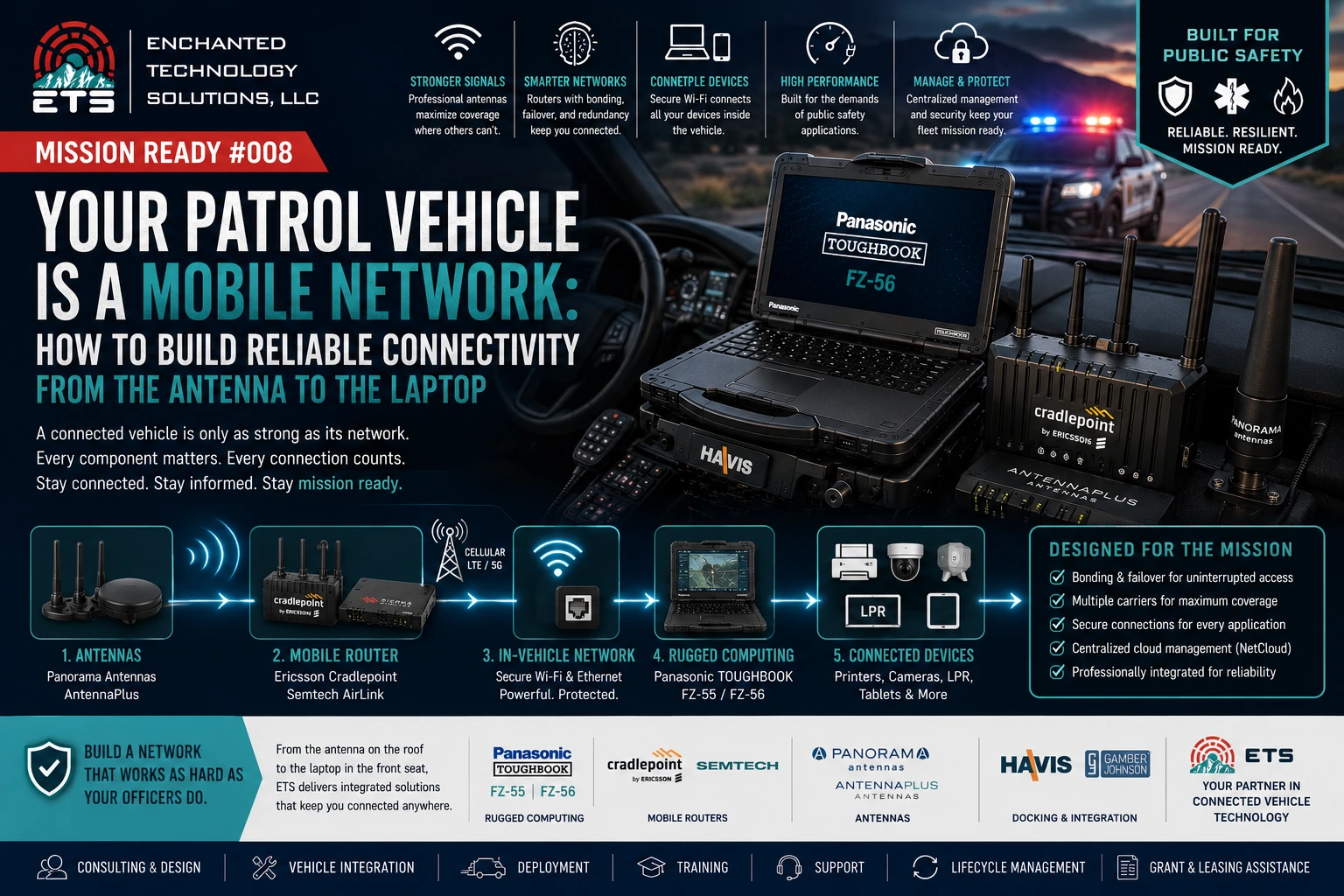
Your Patrol Vehicle Is Now a Mobile Network
A patrol vehicle used to be relatively simple.
An officer had a radio, a flashlight, paper forms, and perhaps a basic computer.
Today, that same vehicle may contain a rugged laptop, cellular router, multiple antennas, mobile printer, camera systems, license plate recognition, GPS, Wi-Fi, and several applications that depend on connectivity.
The patrol vehicle has effectively become a mobile network.
And when that network doesn’t work, much of the technology inside the vehicle doesn’t work either.
For agencies across Arizona, New Mexico, Utah, and Colorado, this creates a unique challenge. Officers may operate in dense urban areas one moment and remote highways, mountain communities, desert regions, or wildfire zones the next.
A reliable mobile network therefore needs to be designed around the mission—not simply around whichever cellular hotspot happens to be available.
Connectivity Is More Than Having a Signal
One of the most common misconceptions about mobile connectivity is that having cellular bars automatically means an agency has a reliable connection.
It doesn’t.
A patrol vehicle may have a cellular signal and still experience:
- Slow application performance
- High latency
- Dropped connections
- Network congestion
- Poor upload speeds
- Unstable connections while moving
- Weak coverage in remote areas
Modern public safety applications can also place significantly more demand on the network than traditional CAD access.
Consider what a single patrol vehicle may be doing simultaneously:
- Running CAD
- Accessing RMS
- Streaming or uploading video
- Using GIS mapping
- Connecting to databases
- Running LPR
- Sending reports
- Communicating through messaging applications
- Supporting multiple connected devices
That is no longer a simple internet connection.
It is a mobile IT infrastructure.
Start With the Antenna
When agencies experience connectivity problems, the router is often the first component they investigate.
But the antenna deserves just as much attention.
The antenna is the part of the system that interacts directly with the wireless environment surrounding the vehicle. Its placement, configuration, and compatibility with the networking equipment can have a significant impact on overall performance.
This is why professional mobile networking solutions typically combine a purpose-built cellular router with appropriately designed external antennas.
ETS provides antenna solutions from:
Panorama Antennas
and
AntennaPlus
These products can be incorporated into a properly engineered vehicle communications system based on the agency’s specific requirements.
The goal isn’t simply to add more antennas.
The goal is to create an antenna configuration that supports the frequencies, technologies, and applications the agency actually uses.
The Router Is the Brain of the Mobile Network
Once the wireless signal reaches the vehicle, the router becomes the central point for managing connectivity.
A professional mobile router can connect multiple devices and services within the vehicle while providing networking, security, and management capabilities designed for mobile environments.
This is fundamentally different from handing an officer a consumer hotspot.
A dedicated vehicle router can provide the foundation for a connected mobile workspace.
Ericsson Cradlepoint: Connectivity Built for Public Safety
Ericsson Cradlepoint offers networking solutions specifically designed for public safety and mobile environments.
Its public safety portfolio includes ruggedized routers and NetCloud management capabilities designed to help agencies deploy, monitor, and manage connected vehicles. Ericsson describes its public safety solutions as supporting secure, always-on connectivity and centralized management, including technologies such as link bonding and secure remote access.
For agencies, the value isn’t simply faster connectivity.
It’s network resiliency and visibility.
A properly designed Cradlepoint deployment can help agencies manage increasingly complex vehicle networks without requiring officers to become network administrators.
When One Cellular Connection Isn’t Enough
This is where modern mobile networking becomes particularly interesting.
A single cellular connection can be affected by:
- Terrain
- Carrier coverage
- Congestion
- Signal degradation
- Network outages
- Movement between coverage areas
For mission-critical applications, agencies may want to consider architectures that use multiple WAN connections.
Ericsson Cradlepoint’s Intelligent Bonding can combine multiple WAN interfaces—including cellular, Ethernet, and Wi-Fi WAN connections—depending on the supported configuration. It can provide functions such as flow balancing, flow duplication, and bandwidth aggregation.
For a wildfire response vehicle, for example, a resilient connectivity architecture can help reduce the impact of a degraded cellular path.
Cradlepoint has also published a validated design specifically modeling a wildfire response vehicle using redundant cellular connectivity and bonding for resiliency.
This is an important shift in thinking:
Don’t design your vehicle network around the assumption that the connection will always be perfect. Design it to continue operating when conditions aren’t perfect.
Standby, Failover, and Bonding Are Not the Same Thing
These terms are sometimes used interchangeably, but they describe different networking strategies.
Failover
A secondary connection becomes available when the primary connection fails.
This is useful when maintaining service continuity is more important than maintaining maximum throughput.
Standby
A secondary connection remains available but isn’t necessarily carrying traffic until it is needed.
Bonding
Multiple connections can participate in a combined connectivity architecture, depending on the technology and configuration.
Cradlepoint’s Intelligent Bonding can use multiple WAN links for flow balancing, flow duplication, or bandwidth aggregation.
The right approach depends on the agency’s applications, coverage environment, budget, and operational requirements.
That’s why vehicle networking should begin with a needs assessment, not a product number.
Semtech AirLink: Another Option for Mission-Critical Mobility
ETS also provides wireless networking solutions from Semtech, including its AirLink portfolio.
Semtech describes its AirLink router portfolio as providing high-performance cellular and Wi-Fi connectivity for demanding applications, including mobile environments. Semtech has specifically highlighted AirLink vehicle routers for public safety and transit applications.
For public safety agencies, these solutions can provide another path toward building a professional mobile network capable of supporting multiple onboard devices and demanding applications.
The appropriate router depends on:
- Vehicle type
- Carrier requirements
- Number of connected devices
- Required bandwidth
- Geographic coverage
- Application requirements
- Security requirements
- Fleet management requirements
The Network Inside the Vehicle Matters Too
The cellular connection is only the first part of the network.
Once connectivity reaches the vehicle, agencies need to determine how devices communicate with the router.
A patrol vehicle may include:
Cellular Network
↓
Vehicle Antennas
↓
Mobile Router
↓
Vehicle LAN / Wi-Fi
↓
TOUGHBOOK
Printer
Camera
LPR System
Other Connected Devices
This architecture turns the patrol vehicle into a distributed mobile network.
The router becomes the central connectivity platform while the other systems become connected endpoints.
The Panasonic TOUGHBOOK Becomes the Officer’s Command Center
At the endpoint of the network is the officer.
That is where the connectivity actually becomes useful.
The Panasonic TOUGHBOOK FZ-55 provides a proven rugged computing platform for agencies that need dependable mobile computing in demanding environments.
The Panasonic TOUGHBOOK FZ-56 gives agencies planning a new technology cycle a next-generation rugged computing option for increasingly data-intensive mobile applications.
These computers can provide access to:
- CAD
- RMS
- Mapping
- Criminal justice databases
- Digital evidence
- Reporting applications
- Communications
- Cloud applications
The laptop doesn’t create the network.
It uses the network.
That distinction is important when troubleshooting vehicle connectivity.
A Better Way to Troubleshoot Connectivity Problems
When an officer says:
“The computer keeps losing connection.”
The laptop isn’t necessarily the problem.
The issue could originate anywhere in the connectivity chain.
Step 1: Check the Application
Is the problem limited to one application or affecting everything?
Step 2: Check the Router
Is the vehicle router connected and functioning properly?
Step 3: Check the Cellular Connection
Is the cellular WAN experiencing degradation or congestion?
Step 4: Check the Antenna
Is the antenna properly installed and connected?
Step 5: Check the Vehicle Installation
Are cables, connectors, power, and mounting systems functioning properly?
Step 6: Check the Carrier
Is there a coverage or network issue affecting the area?
This systems-level approach is one reason professional vehicle integration is so important.
NetCloud Management Can Give IT Teams Visibility
Managing one connected patrol vehicle is relatively simple.
Managing 25, 50, 100, or 500 vehicles is an entirely different challenge.
Ericsson Cradlepoint’s NetCloud platform provides centralized management capabilities for connected devices. Ericsson describes NetCloud as supporting centralized deployment, monitoring, updates, and network management for public safety environments.
This can help IT teams understand:
- Which devices are online
- Which vehicles are experiencing problems
- Network health
- Connectivity conditions
- Configuration status
- Fleet-wide deployments
The objective is to move from reactive troubleshooting to proactive fleet management.
Why This Matters During Wildfire Season
Consider a large wildfire response.
A fleet may include:
- Patrol vehicles
- Fire apparatus
- Command vehicles
- EMS units
- Emergency management vehicles
- Mutual aid vehicles
Personnel may be working far from their normal stations while sharing information across multiple agencies.
At that point, connectivity becomes part of the incident infrastructure.
Reliable mobile networking can support:
- Mapping
- Evacuation information
- CAD
- Incident reporting
- Digital communications
- Video
- GPS
- Situational awareness
And because wildfire environments can be unpredictable, agencies should plan for degraded connectivity rather than assuming that one cellular connection will always be sufficient.
Rural Agencies Have Different Connectivity Challenges
Not every agency has the same network requirements.
An urban police department may be surrounded by cellular infrastructure.
A rural sheriff’s office may cover hundreds or thousands of square miles.
A highway patrol unit may spend most of its shift moving between communities.
A public safety agency serving mountainous terrain may encounter rapid changes in signal conditions.
The solution therefore isn’t necessarily “the fastest router.”
The solution is the architecture that best matches the mission.
That may involve:
- Multiple cellular carriers
- External antennas
- Multi-WAN connectivity
- Bonding
- Failover
- Centralized management
- Secure remote access
Don’t Forget the Installation
One of the easiest ways to undermine an otherwise excellent networking system is poor installation.
Vehicle integration should account for:
- Antenna placement
- Cable routing
- Power requirements
- Equipment ventilation
- Vehicle electronics
- Mounting locations
- Serviceability
- Future upgrades
A router sitting in a vehicle is not the same thing as a professionally integrated mobile network.
ETS helps agencies bridge that gap.
Building the ETS Connected Patrol Vehicle
A modern ETS-connected patrol vehicle can be designed around several layers:
1. Rugged Computing
Panasonic TOUGHBOOK FZ-55 / FZ-56
The officer’s primary mobile computing platform.
2. Secure Docking
Havis / Gamber-Johnson
Provides secure mounting, power, and connectivity integration.
3. Mobile Networking
Ericsson Cradlepoint / Semtech AirLink
Provides the vehicle’s primary connectivity platform.
4. External Antennas
Panorama / AntennaPlus
Supports the vehicle’s wireless infrastructure.
5. Mobile Printing
Brother PocketJet
Allows officers to print necessary documents from the field.
6. Surveillance and Situational Awareness
Panasonic i-PRO / ELSAG
Supports video and license plate recognition applications.
7. Security
DigitalPersona / Absolute Secure Access / Eclypsium
Adds authentication, secure access, and device security capabilities.
The result is a technology ecosystem—not a collection of unrelated products.
Why ETS Takes a Systems Approach
This is where Enchanted Technology Solutions can provide value beyond simply selling a router or laptop.
A public safety agency doesn’t need another box.
It needs a solution that works.
ETS can help agencies evaluate:
- Existing fleet technology
- Current connectivity
- Vehicle configuration
- Computing requirements
- Security requirements
- Future technology needs
- Fleet replacement schedules
From there, ETS can help with:
- Product selection
- Vehicle integration
- Installation
- Deployment
- Configuration
- Lifecycle support
- Grant assistance
- Leasing options
The goal is to create a mobile technology environment that remains reliable as the agency’s needs evolve.
Frequently Asked Questions
What is a mobile router?
A mobile router is a networking device designed to provide connectivity for vehicles and other mobile environments. Unlike a basic hotspot, professional mobile routers can support multiple connected devices and may provide advanced networking, security, management, and redundancy capabilities.
Why does a patrol vehicle need an external antenna?
External antennas can provide the wireless infrastructure necessary for a professionally designed vehicle network. The appropriate antenna configuration depends on the router, frequencies, carriers, vehicle, and applications being supported.
Is Cradlepoint better than Semtech?
Neither is universally “better.” Both offer professional mobile networking solutions. The right choice depends on the agency’s operational requirements, desired features, carrier environment, management needs, and budget.
What is cellular bonding?
Cellular bonding combines multiple WAN connections into a connectivity architecture. Depending on the solution and configuration, traffic may be balanced, duplicated for resiliency, or aggregated across links. Ericsson Cradlepoint’s Intelligent Bonding supports these approaches.
Can ETS upgrade an existing patrol vehicle?
Yes. Existing vehicles can often be evaluated for connectivity, computing, docking, antenna, and other technology upgrades rather than requiring an entirely new vehicle.
Why should agencies use a professional integrator?
A professional integrator evaluates how the different components work together—including networking, power, antennas, computing, mounting, security, and vehicle configuration—rather than treating each product as a separate purchase.
Final Thoughts
The modern patrol vehicle isn’t simply a car carrying a laptop.
It is a mobile network supporting a mobile officer.
When the antenna, router, connectivity architecture, rugged computer, docking system, security tools, and vehicle installation are designed together, agencies can build a much more reliable technology platform.
For public safety agencies across Arizona, New Mexico, Utah, and Colorado, that matters.
The mission doesn’t stop when an officer leaves the coverage of headquarters.
The technology shouldn’t either.
Ready to evaluate your patrol fleet’s connectivity? Contact Enchanted Technology Solutions to discuss a complete mobile networking solution built around Ericsson Cradlepoint, Semtech, Panorama, AntennaPlus, Panasonic TOUGHBOOK FZ-55/FZ-56, and professional vehicle integration.