

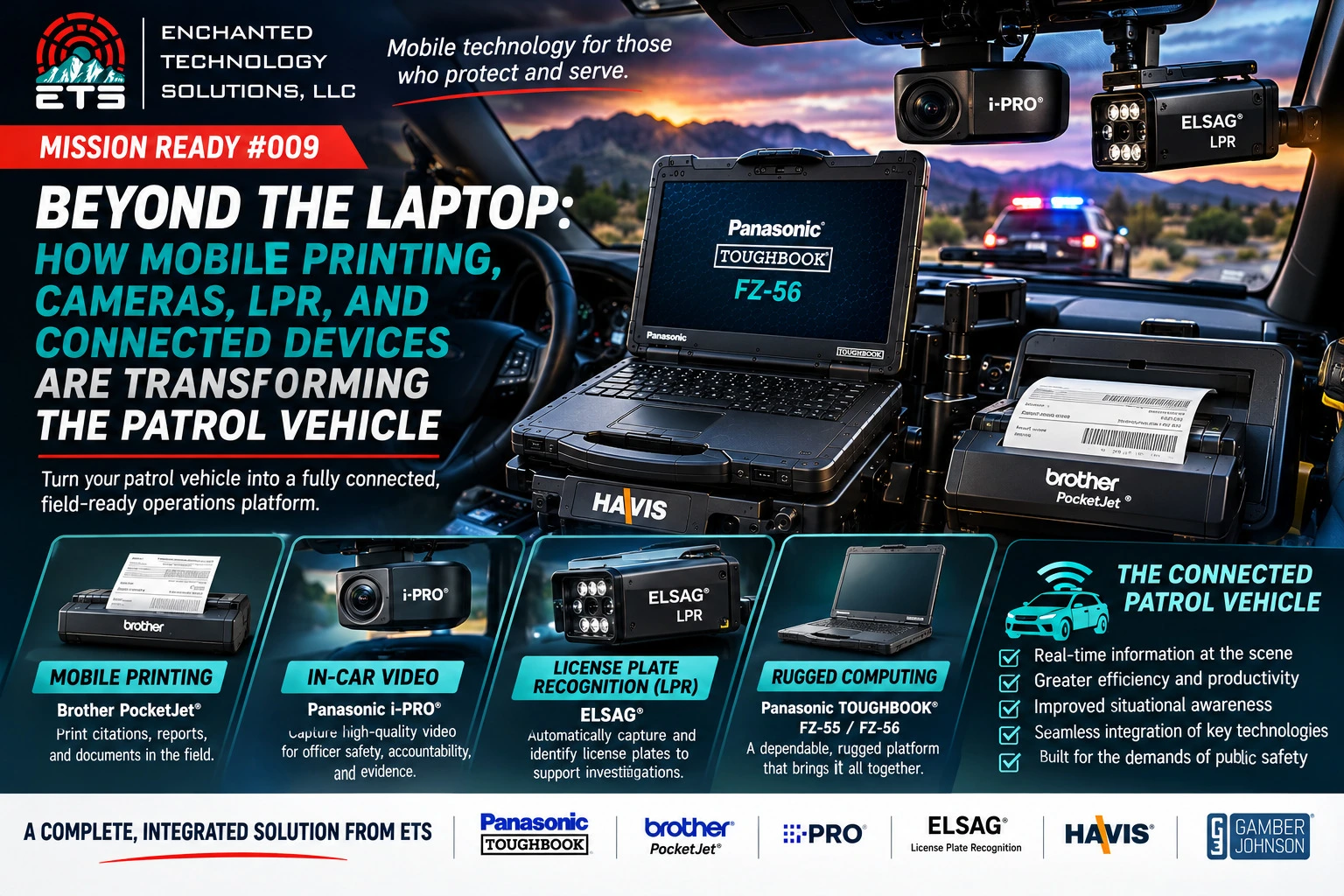
The Modern Patrol Vehicle Is More Than a Computer on Wheels
When agencies think about upgrading their patrol vehicles, the first piece of equipment that usually comes to mind is the mobile computer.
And for good reason.
Officers depend on rugged laptops to access Computer-Aided Dispatch (CAD), Records Management Systems (RMS), criminal justice databases, mapping applications, and reporting software.
But the modern patrol vehicle has evolved far beyond a laptop and a radio.
Today’s law enforcement vehicles can function as fully connected field operations platforms, equipped with mobile printers, in-car video systems, automatic license plate recognition (ALPR), wireless routers, antennas, and other connected devices.
Each technology serves a different purpose, but when properly integrated, they can help officers complete more tasks from the field, improve situational awareness, and reduce unnecessary administrative delays.
For police departments and sheriff’s offices across Arizona, New Mexico, Utah, and Colorado, investing in these technologies can be particularly valuable. Agencies often cover large territories, respond to incidents in remote locations, and operate under demanding environmental conditions.
The goal is not to put more equipment inside a patrol vehicle.
The goal is to give officers the right tools to perform their responsibilities more effectively.
1. Mobile Printing: Complete More Work Without Returning to the Station
One of the most overlooked components of a modern patrol vehicle is the mobile printer.
Many agencies have transitioned to electronic citations and digital reporting. However, there are still situations where officers need to provide printed documents, complete paperwork, or produce physical copies of important information.
Returning to the station simply to print a document creates unnecessary interruptions.
A mobile printer allows officers to complete these tasks directly from their vehicles or in the field.
Why Mobile Printing Still Matters
Law enforcement officers regularly handle documentation such as:
- Traffic citations
- Accident and crash reports
- Warnings
- Tow and impound forms
- Inspection notices
- Driver information exchanges
- Incident-related paperwork
- Other agency-specific documents
Having printing capabilities available in the patrol vehicle can reduce unnecessary trips to headquarters and help officers complete documentation closer to the time and location of an incident.
It can also support more consistent workflows when officers need to provide physical documents to motorists or other parties.
Product Spotlight: Brother PocketJet Mobile Printers
FEATURED ETS PRODUCT
Brother PocketJet 8 PJ823 Monochrome USB Mobile Thermal
Brother PocketJet
Compact, portable full-page thermal printing designed for mobile professionals and public safety field operations.
The Brother PocketJet series provides a practical solution for agencies that need full-page printing capabilities inside patrol vehicles.
Unlike traditional office printers, PocketJet printers use direct thermal printing technology, eliminating the need for conventional ink or toner cartridges.
Depending on the model, PocketJet printers offer USB, Bluetooth, and Wi-Fi connectivity options.
The newer PocketJet 8 family includes models such as the PocketJet 822, 823, 862, 863, and 883, with different connectivity and resolution configurations. Agencies should select a model based on their existing computer platforms, printing applications, and deployment requirements. PocketJet 8+2
How PocketJet Can Help Your Agency
- Print documents directly from a patrol vehicle.
- Reduce trips back to the station.
- Support field documentation.
- Provide printed citations and reports.
- Reduce the need for traditional ink and toner.
- Integrate mobile printing into an existing workstation.
For agencies operating across rural communities in New Mexico, Utah, Arizona, and Colorado, the ability to complete documentation in the field can help improve workflow efficiency.
The operational benefit: Less time spent traveling back to headquarters and more time available for patrol responsibilities.
2. In-Car Video: Improving Visibility and Accountability
A patrol vehicle is often the first point of contact between an officer and a developing situation.
Whether responding to a traffic stop, transporting an individual, conducting an investigation, or managing a roadside incident, having reliable video documentation can be valuable for both officers and their agencies.
In-car video systems help agencies capture events that occur around and inside the patrol vehicle, depending on the camera configuration.
These systems can support:
- Incident documentation
- Evidence collection
- Traffic stop recording
- Officer accountability
- Investigative review
- Improved situational awareness
Video technology is also an important component of an agency’s broader digital evidence strategy.
Product Spotlight: Panasonic i-PRO Surveillance and In-Car Video
Vehicle Camera Systems | i-PRO Products
Panasonic i-PRO
Professional video surveillance and in-car video solutions designed for demanding security and public safety applications.
Panasonic’s former security business now operates under the i-PRO brand.
Its public safety video portfolio includes in-car video solutions designed for law enforcement vehicles.
For example, the i-PRO ICV4000 in-car video system includes camera options for recording vehicle activity. Its WV-VCR40W rear/side camera was introduced with edge AI human detection features, including detection of people in the back seat and people approaching the vehicle. Depending on configuration, these features can trigger recording and alerts. i-PRO Products
Why In-Car Video Matters
Consider a routine traffic stop.
An officer approaches a vehicle, communicates with the driver, and conducts the necessary checks. During that interaction, several things may happen outside the officer’s immediate field of view.
A properly configured in-car video system can provide additional documentation of the encounter.
Similarly, cameras covering the rear passenger area may help document activity during prisoner transport.
These capabilities can support agency policies, investigations, and evidence review.
What Agencies Should Evaluate
When considering an in-car video upgrade, agencies should evaluate:
- Camera placement and coverage
- Video resolution
- Recording triggers
- Storage capacity
- Evidence retention requirements
- Integration with existing systems
- Video retrieval and management
- Network and bandwidth requirements
- Applicable privacy and recording policies
An in-car video system should be selected based on the agency’s operational and evidence-management requirements, not simply camera specifications.
The operational benefit: Better documentation, additional visibility, and more comprehensive video evidence for incidents involving patrol vehicles.
3. License Plate Recognition: Giving Officers More Information in the Field
Another important technology transforming modern patrol vehicles is Automatic License Plate Recognition (ALPR), also commonly called License Plate Recognition (LPR).
Instead of requiring officers to manually enter every license plate they encounter, ALPR systems use specialized cameras and software to capture and process plate information.
Depending on the system and agency configuration, recognized plate information can be compared against authorized databases or hotlists.
When a match occurs, the system may generate an alert for further investigation.
This can help officers identify vehicles associated with matters such as stolen vehicles, wanted persons, or other agency-defined investigative priorities.
Product Spotlight: ELSAG License Plate Recognition
Mini Camera for ALPR | Police Magazine
ELSAG
ALPR technology designed to help law enforcement agencies capture, search, and analyze vehicle-related information.
ELSAG provides license plate recognition technology for law enforcement and other applications.
Its solutions can help agencies capture license plate information and compare recognized plates against configured hotlists.
ELSAG’s broader technology portfolio also includes investigative tools for searching and analyzing captured vehicle information. stpsprodwe.blob.core.windows.net
How ALPR Can Support Patrol Operations
Consider an officer conducting routine patrol along a major highway.
A vehicle passes through the patrol area. An ALPR system can capture its plate information and compare it against the agency’s configured data sources.
If a relevant match is identified, the officer may receive an alert to review and determine the appropriate next step.
Potential operational applications include:
- Identifying vehicles reported stolen
- Supporting investigations involving suspect vehicles
- Identifying vehicles associated with authorized hotlists
- Assisting investigative searches
- Supporting regional information-sharing efforts
Why This Matters in the Southwest
Agencies in Arizona, New Mexico, Utah, and Colorado often operate across extensive highway networks and geographically dispersed communities.
ALPR technology can be particularly relevant for agencies that need additional tools to identify vehicles of investigative interest across large patrol territories.
However, technology alone does not determine whether a vehicle should be stopped or whether a person is involved in criminal activity.
Agencies must establish appropriate policies for alert verification, officer response, data retention, access permissions, and privacy.
The operational benefit: More efficient vehicle identification and additional investigative information to support informed decisions in the field.
4. Rugged Computing: Bringing Every Connected Device Together
Mobile printers, video systems, and ALPR technology each serve important functions.
But they become much more useful when officers have a dependable computing platform that allows them to access and manage the information they need.
This is where the Panasonic TOUGHBOOK platform becomes central to the patrol vehicle.
Product Spotlight: Panasonic TOUGHBOOK FZ-55 and FZ-56
Panasonic TOUGHBOOK FZ-56
A next-generation semi-rugged computing platform for agencies planning to modernize their mobile workstations.
TOUGHBOOK 55 Series | Panasonic Connect
Panasonic TOUGHBOOK FZ-55
A proven rugged mobile computing platform for demanding business and public safety environments.
The TOUGHBOOK FZ-55 and FZ-56 can serve as the primary computing platforms inside a modern patrol vehicle.
They provide agencies with options for supporting the applications officers depend on every day.
These may include:
- CAD and RMS
- Digital reporting
- Mapping applications
- Criminal justice databases
- Video review
- LPR applications
- Mobile printing software
- Secure communications
- Digital evidence workflows
The FZ-55 remains an option for agencies seeking a proven platform, while the FZ-56 provides an opportunity to plan for a newer generation of mobile computing.
The appropriate configuration depends on application compatibility, processing requirements, connectivity, docking requirements, and agency budget.
Why Integration Matters
Imagine an officer completing a traffic stop.
The officer uses the TOUGHBOOK to access dispatch information, checks relevant records, completes documentation, and prints the necessary paperwork through a Brother PocketJet printer.
Meanwhile, the in-car video system records the encounter, and the vehicle’s other connected systems perform their designated functions.
Instead of treating these technologies as separate purchases, agencies should plan how they will work together.
The operational benefit: A unified mobile workstation that supports multiple field responsibilities through one connected environment.
5. Connectivity: The Foundation Behind Every Connected Device
Every connected device inside a patrol vehicle depends on reliable networking.
A printer needs to communicate with a computer or mobile device.
A camera system may need to transfer video or communicate with a recording platform.
An ALPR solution may need access to configured databases or management systems.
The rugged laptop needs access to CAD, RMS, and other agency applications.
This is why mobile networking is an essential part of fleet modernization.
ETS provides connectivity solutions from:
- Ericsson Cradlepoint – Professional mobile networking and vehicle routers.
- Semtech AirLink – Wireless networking solutions for demanding mobile environments.
- Panorama Antennas – Vehicle antenna solutions.
- AntennaPlus – Antenna solutions for wireless communications.
When properly selected and integrated, these technologies help create the network infrastructure that supports a connected patrol vehicle.
Agencies should evaluate the number of connected devices, carrier coverage, bandwidth requirements, network security, and data-management policies before selecting their networking configuration.
6. Building a Connected Patrol Vehicle: How Everything Works Together
A modern patrol vehicle should be designed as an integrated technology platform.
Consider the following example:
A connected patrol vehicle ecosystem
Mobile Connectivity
Cradlepoint / Semtech / Panorama / AntennaPlus
Rugged Computing
Panasonic TOUGHBOOK FZ-55 / FZ-56
Mobile Printing
Brother PocketJet
In-Car Video
Panasonic i-PRO
License Plate Recognition
ELSAG
Cybersecurity
DigitalPersona / Absolute / Eclypsium
Illustrative architecture. Actual device connections, interfaces, and integrations depend on the selected products, software, and agency configuration.
The value of this approach is that each technology has a defined role.
Rather than purchasing individual products without considering compatibility, agencies can plan a complete solution around their operational needs.
7. Professional Vehicle Integration: Making Everything Work Together
Purchasing quality equipment is only the beginning.
One of the biggest challenges agencies face is ensuring that every component is properly installed, configured, and integrated into the patrol vehicle.
A mobile printer that cannot communicate with the laptop is not useful.
A camera system that doesn’t fit the agency’s evidence workflow creates additional work.
An ALPR system that isn’t properly configured may not deliver the expected operational value.
Even the best rugged computer can become difficult to use if its mounting position interferes with officer ergonomics.
This is why professional vehicle integration matters.
What Should Agencies Consider?
Before deploying new technology, agencies should evaluate:
- Vehicle compatibility
- Equipment placement
- Power requirements
- Docking and mounting systems
- Cable management
- Network configuration
- Software compatibility
- Data storage and retention
- Officer accessibility
- Future maintenance requirements
ETS helps agencies approach these projects as complete technology deployments rather than individual hardware purchases.
8. Why Agencies Choose Enchanted Technology Solutions
Modern public safety technology requires a partner who understands how different products work together.
Enchanted Technology Solutions (ETS) works with public safety agencies throughout Arizona, New Mexico, Utah, and Colorado, helping them identify, procure, deploy, and support technology designed for demanding field operations.
Our public safety technology portfolio includes:
| Technology Category | ETS Solutions |
|---|---|
| Rugged Computing | Panasonic TOUGHBOOK FZ-55 and FZ-56 |
| Docking Systems | Havis and Gamber-Johnson |
| Mobile Printing | Brother PocketJet |
| In-Car Video | Panasonic i-PRO |
| License Plate Recognition | ELSAG |
| Mobile Networking | Ericsson Cradlepoint and Semtech |
| Antennas | Panorama and AntennaPlus |
| Authentication | DigitalPersona |
| Secure Access | Absolute Secure Access |
| Endpoint Security | Eclypsium |
Beyond supplying equipment, ETS can support agencies through:
- Technology consulting and planning
- Fleet assessments
- Product selection and procurement
- Vehicle installation and integration
- Equipment deployment
- Configuration and testing
- Technical support
- Warranty coordination
- Lifecycle management
- Grant assistance
- Leasing options
Our goal is to help agencies build a technology environment that supports officers throughout their daily operations.
One technology partner. Multiple integrated solutions. One mission: keeping public safety agencies connected and mission ready.
9. How to Evaluate Your Agency’s Current Patrol Vehicle Technology
Before investing in new equipment, it is worth examining how your existing technology performs.
Here are several questions agency leaders should consider.
| Assessment Area | Questions to Ask |
|---|---|
| Mobile Computing | Are patrol laptops reliable and compatible with current applications? |
| Mobile Printing | Can officers print required documents directly from the field? |
| Video | Does the current in-car video system meet recording and evidence requirements? |
| ALPR | Does the agency have the appropriate vehicle identification capabilities? |
| Connectivity | Can officers reliably access their applications throughout their patrol areas? |
| Integration | Do all devices work together as intended? |
| Lifecycle | Are aging devices increasing maintenance and replacement costs? |
| Security | Are access, evidence, and device protection controls appropriate? |
An assessment can help identify gaps, prioritize investments, and develop a realistic fleet modernization plan.
Not every agency needs every technology.
A smaller department may prioritize rugged laptops, mobile printers, and reliable connectivity. A larger department may have additional requirements for in-car video, ALPR, centralized device management, and digital evidence integration.
The right solution is the one that addresses the agency’s actual operational needs.