

How Public Safety Agencies Can Secure Mobile Computers, Remote Access, and Field Connectivity
Criminal Justice Information Doesn’t Stay at the Station Anymore
Public safety agencies have undergone a fundamental change in how they access and use information.
A police officer sitting at a workstation inside a secure police facility is no longer the only environment where sensitive criminal justice information is accessed. Today, officers and deputies may access critical systems from a patrol vehicle, a roadside location, a temporary command post, a wildfire staging area, or another remote location.
That mobility creates tremendous operational advantages.
It also creates additional security responsibilities.
The Federal Bureau of Investigation’s CJIS Security Policy specifically recognizes that mobile devices create unique security challenges because protections available in a fixed facility may not automatically exist when a device is being used in the field. The FBI’s mobile guidance addresses areas such as authentication, Wi-Fi, encryption, administrative access, certificates, and physical protection of mobile devices.
For agencies in Arizona, Colorado, New Mexico, and Utah, where officers may routinely operate across large geographic areas, protecting information outside the station is particularly important.
The question isn’t whether officers need mobile technology.
They do.
The question is:
How can agencies give officers the information they need without creating unnecessary security risks?
The Patrol Vehicle Is Now Part of the Cybersecurity Perimeter
A modern patrol vehicle may contain:
- A rugged laptop or tablet
- Cellular connectivity
- Wi-Fi
- CAD access
- RMS access
- Criminal justice databases
- Digital evidence
- Mobile printers
- GPS and mapping
- Cameras
- License plate recognition
- Cloud applications
The vehicle is essentially a mobile extension of the agency’s IT environment.
That means cybersecurity cannot stop at the firewall inside headquarters.
The security strategy has to follow the officer.
Why Mobile Devices Require Additional Security Considerations
Mobile devices operate in environments that are fundamentally different from traditional office workstations.
A patrol laptop may be:
- Mounted inside a vehicle
- Connected through cellular networks
- Used outside a secure facility
- Exposed to theft or unauthorized physical access
- Connected to multiple networks
- Used by personnel who need rapid access during emergencies
The FBI’s CJIS mobile guidance specifically notes that physical protection becomes an important consideration because mobile devices are often stored in vehicles and other locations where the physical protections of a secure facility aren’t available.
This means agencies need a layered approach to security.
Layer 1: Secure the Device
The first layer is the physical endpoint itself.
For many agencies, that endpoint is a rugged Panasonic TOUGHBOOK® computer.
The Panasonic TOUGHBOOK FZ-55 provides a proven rugged computing platform for demanding public safety environments, while the TOUGHBOOK FZ-56 provides a next-generation option for agencies planning a longer-term technology refresh.
But ruggedness and cybersecurity are two different things.
A computer can be physically durable and still require strong security controls.
That’s why agencies should consider the complete security architecture surrounding the device—not simply the hardware specifications.
Layer 2: Strengthen Authentication
A username and password alone may not provide the level of protection an agency needs for sensitive information.
Advanced authentication can add another layer between an unauthorized individual and the agency’s systems.
ETS offers DigitalPersona solutions as part of its public safety technology portfolio, giving agencies an option to incorporate stronger authentication into their mobile computing environment.
This is particularly important when devices are being used outside controlled facilities.
The objective is simple:
Make sure the person accessing sensitive information is actually authorized to do so.
The FBI’s mobile guidance also discusses advanced authentication and notes that mobile environments may require additional layers of access control beyond a basic device PIN or password when accessing CJI.
Layer 3: Protect the Connection
Even when the device itself is secure, agencies must consider how it connects to internal applications and resources.
Patrol vehicles increasingly rely on cellular networks and mobile routers to connect officers to agency systems.
That creates another security consideration:
How do you securely connect a mobile officer to the applications they need without exposing the broader network?
ETS offers Absolute Secure Access, a solution designed for mobile and field workers that provides secure access to private applications, cloud services, and websites. Absolute describes its current Secure Access portfolio as a resilient Security Service Edge platform designed for hybrid, mobile, and field workforces.
For public safety agencies, this can help address the reality that officers need secure access while operating outside the traditional network perimeter.
Connectivity and Security Have to Work Together
Security shouldn’t make officers wait for the network to respond.
When officers are dealing with an emergency, technology has to work without creating unnecessary friction.
Absolute specifically positions its public safety offering around secure and resilient access for law enforcement and first responders, including maintaining access during challenging network conditions.
This is an important consideration for agencies operating throughout the Southwest.
An officer may leave a station with strong connectivity and then travel through:
- Rural highways
- Mountain passes
- Tribal lands
- Desert areas
- Remote communities
- Wildfire zones
A secure connection that cannot maintain operational usability is not an ideal field solution.
Agencies should therefore evaluate security and connectivity together.
Layer 4: Don’t Forget What’s Beneath the Operating System
Traditional endpoint security often focuses heavily on the operating system, applications, and user activity.
But modern cybersecurity increasingly recognizes that threats can exist deeper within the device.
This is where Eclypsium becomes relevant.
Eclypsium provides visibility into hardware and firmware security, including continuous monitoring for firmware vulnerabilities, misconfigurations, compromised firmware, rootkits, and bootkits.
For public sector organizations, Eclypsium specifically identifies support for state and local law enforcement requirements, including CJIS-related security needs.
The concept is important:
You can’t fully secure a device if you can’t see what’s happening at the device level.
Why Firmware Security Matters for Public Safety
An officer’s laptop is not just another computer.
It can contain or provide access to:
- Credentials
- Authentication tokens
- Agency applications
- Sensitive records
- Criminal justice information
- Network access
A compromise beneath the operating system can therefore present a particularly serious risk.
Eclypsium’s endpoint security platform is designed to identify hardware and firmware vulnerabilities that traditional endpoint tools may not see and to monitor device integrity continuously.
For agencies developing a modern cybersecurity strategy, this creates another layer of visibility beyond traditional endpoint protection.
Layer 5: Plan for Lost or Stolen Devices
Mobile devices have a physical risk that stationary computers don’t.
A patrol laptop may be stolen from a vehicle.
A tablet could be misplaced during an incident.
A device could be compromised.
Agencies therefore need procedures for:
- Device inventory
- Remote management
- Access revocation
- Data protection
- Device recovery
- Incident response
Absolute’s public safety platform includes capabilities for remotely tracking and managing device fleets, freezing devices, and remotely deleting files or wiping devices when necessary.
These capabilities can become an important part of an agency’s broader mobile device security strategy.
Security Shouldn’t Make the Officer’s Job Harder
One of the biggest mistakes agencies can make is treating cybersecurity as something separate from operations.
Officers don’t want five different authentication screens before they can see a dispatch call.
They don’t want complicated connectivity procedures while responding to an emergency.
They need technology that is:
Secure. Simple. Reliable. Fast.
The best mobile security strategy is therefore one that operates largely in the background while maintaining strong controls.
That requires thoughtful architecture—not simply adding more security products.
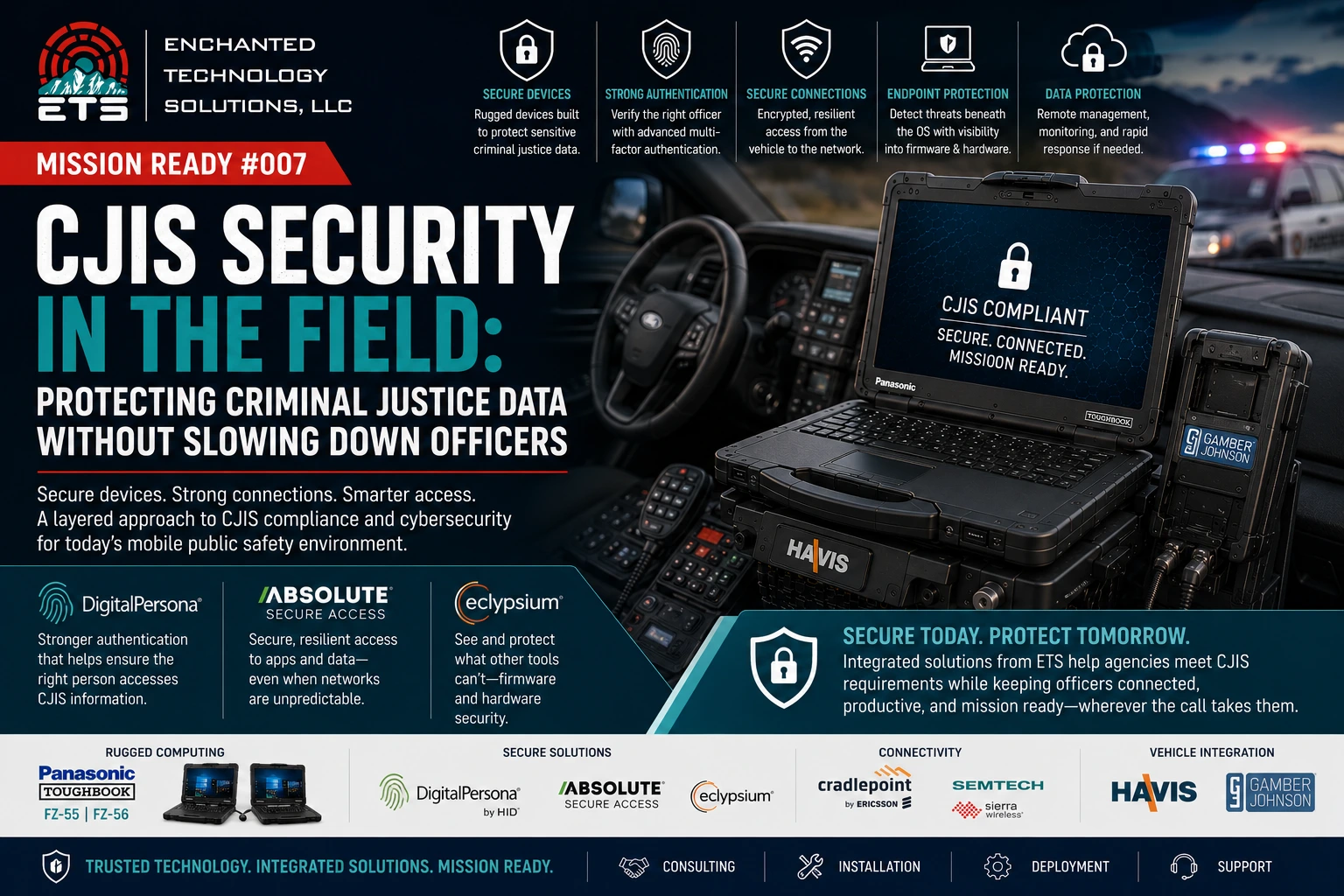
Building a Secure Mobile Public Safety Environment
A comprehensive mobile security strategy can include several layers working together:
Rugged Computing
Panasonic TOUGHBOOK FZ-55 and FZ-56
Provides a durable mobile computing platform designed for demanding field environments.
Authentication
DigitalPersona
Provides additional authentication capabilities to help control access to sensitive systems.
Secure Remote Access
Absolute Secure Access
Provides secure, resilient access to applications and resources for mobile and field users.
Device and Firmware Security
Eclypsium
Provides visibility and protection at the hardware and firmware level, helping agencies identify risks that traditional endpoint tools may miss.
Vehicle Integration
Havis and Gamber-Johnson
Securely integrate rugged computers into patrol vehicles while supporting a reliable mobile workspace.
Connectivity
Ericsson Cradlepoint and Semtech
Provide mobile networking options that help officers maintain access while operating in the field.
Antennas
Panorama and AntennaPlus
Support the wireless infrastructure inside the vehicle.
Together, these technologies create a more complete approach to protecting the modern mobile public safety environment.
CJIS Security Is More Than Buying a “CJIS-Compliant Laptop”
This is an important distinction for agencies.
There is no single laptop that magically makes an entire mobile environment CJIS compliant.
CJIS security involves policies, procedures, technical controls, authentication, encryption, access management, physical protection, network configuration, personnel practices, and other safeguards.
The FBI’s mobile guidance emphasizes that agencies need to consider how mobile-specific technologies are configured and how compensating controls may be necessary in environments where traditional protections aren’t available.
Therefore, agencies should avoid evaluating mobile security based solely on a product label.
Instead, evaluate the entire system.
A Better Question for Your Next Fleet Upgrade
Instead of asking:
“Which laptop should we buy?”
Ask:
“How do we want our officers to securely access information from anywhere they work?”
That question changes the conversation.
It brings together:
- Computing
- Connectivity
- Authentication
- Cybersecurity
- Vehicle integration
- Device management
- Lifecycle planning
And it creates an opportunity to design a technology environment rather than simply replace aging hardware.
How ETS Helps Agencies Build Secure Mobile Workspaces
Enchanted Technology Solutions works with public safety agencies throughout Arizona, Colorado, New Mexico, and Utah to help plan and deploy integrated technology environments.
ETS can support agencies with:
- Panasonic TOUGHBOOK® FZ-55 and FZ-56
- Rugged tablets
- Havis and Gamber-Johnson docking systems
- Ericsson Cradlepoint mobile networking
- Semtech wireless solutions
- Panorama and AntennaPlus antennas
- DigitalPersona authentication
- Absolute Secure Access
- Eclypsium device and firmware security
- Brother PocketJet mobile printers
- Panasonic i-PRO surveillance
- ELSAG license plate recognition
- Vehicle installation and integration
- Technology planning
- Deployment and fulfillment
- Grant assistance
- Leasing options
- Lifecycle support
The goal isn’t to add technology for technology’s sake.
It’s to help agencies create a secure, reliable, mission-ready mobile environment that supports officers without unnecessarily complicating their work.
Frequently Asked Questions
What is CJIS security for mobile devices?
CJIS security for mobile devices involves applying appropriate security controls when devices access or handle criminal justice information outside traditional secure facilities. The FBI provides mobile-specific guidance covering areas such as authentication, wireless connectivity, encryption, administrative access, certificates, and physical protection.
Is a rugged laptop automatically CJIS compliant?
No. Rugged construction addresses physical durability, but CJIS security involves the broader technology environment, policies, configurations, authentication, access controls, encryption, and other safeguards.
Why is multi-factor or advanced authentication important?
Mobile devices can be physically exposed and may operate outside controlled facilities. Additional authentication layers can help reduce the risk of unauthorized access to sensitive systems.
Why should agencies consider firmware security?
Firmware operates beneath the operating system and can contain vulnerabilities or be targeted by attacks that traditional endpoint security tools may not detect. Eclypsium provides visibility into firmware and hardware security as an additional layer of device protection.
Can secure access affect officer productivity?
It can if poorly designed. Modern secure-access solutions are intended to balance security with usability. Absolute, for example, positions its Secure Access platform around resilient connectivity and secure access for mobile and field workers.
Final Thoughts
Public safety agencies can’t afford to choose between security and operational effectiveness.
Officers need access to critical information wherever the mission takes them—but that access must be protected.
As patrol vehicles become increasingly connected mobile offices, cybersecurity needs to become part of the vehicle technology strategy from the beginning.
A modern approach may combine a Panasonic TOUGHBOOK FZ-55 or FZ-56, secure authentication, resilient remote access, firmware-level device protection, professional vehicle integration, and dependable mobile connectivity.
The result is more than a secure laptop.
It’s a secure mobile public safety environment.
Enchanted Technology Solutions helps agencies evaluate these technologies as part of a larger mission—not as disconnected products.
Ready to evaluate the security of your agency’s mobile technology? Contact Enchanted Technology Solutions to discuss how we can help you build a secure, reliable, and mission-ready mobile environment for your officers and first responders.