

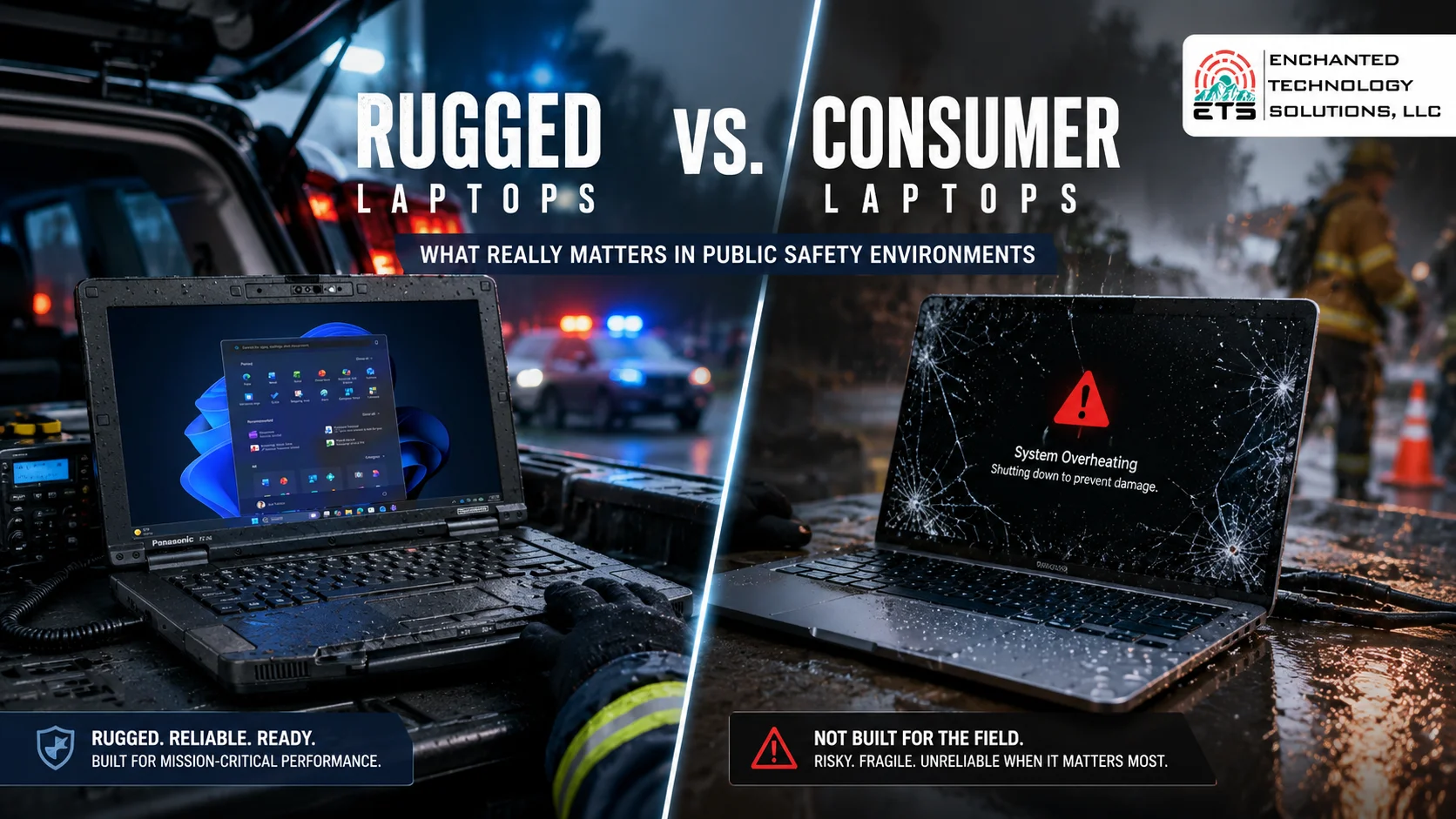
For a public safety agency, the decision between a high-end consumer laptop and a purpose-built rugged device often comes down to the “sticker price.” However, in mission-critical environments, the real cost of a device isn’t the price on the box, it’s the cost of it failing when an officer or medic needs it most.
Here is a breakdown of what actually differentiates these two categories and why those differences matter in the field.
1. Survivability Standards: Beyond Marketing Terms
When a consumer laptop is labeled “durable,” it usually means it has a metal finish. When a Panasonic Toughbook is called “rugged,” it means it has passed rigorous, standardized testing.
- MIL-STD-810H: This is a U.S. military standard that involves up to 29 different tests, including 6-foot drops, intense vibration (like a vehicle idling for 10 hours a day), and thermal shock.
- IP Ratings (Ingress Protection): These ratings (like IP65 or IP66) tell you exactly how much dust and water the device can handle. A high IP rating means an officer can type a report in a downpour or a dusty field without the internal electronics frying.
2. Visibility and Usability in the Field
Consumer laptops are designed for indoor use. Take them outside, and you’ll notice two immediate failures:
- The Screen Washout: Standard screens usually offer 200–300 nits of brightness. Rugged laptops often feature 1,000+ nit daylight-readable displays, allowing users to see critical data even in direct, high-noon sunlight.
- Glove-Touch Capability: In an emergency, first responders don’t have time to take off their work or medical gloves. Rugged screens are designed with advanced “glove-touch” technology that consumer tablets simply lack.
3. Lifecycle and “Total Cost of Ownership” (TCO)
A major mistake agencies make is viewing a laptop as a 2-year disposable item.
- Consumer Lifecycle: Consumer models change every 6–12 months. If you buy 10 laptops today and need 2 more next year, the original model is likely discontinued, making parts and vehicle docks obsolete.
- Rugged Lifecycle: Devices like the Toughbook are designed for 5–8 year lifecycles. This means your mounting systems, power adapters, and software configurations remain stable for nearly a decade, significantly lowering the Total Cost of Ownership.
4. Thermal Management: The “Patrol Car” Test
Standard consumer or office technology simply doesn’t survive or perform reliably in the harsh, mobile, and mission-critical environments where public safety agencies operate. For example, a laptop sitting in a patrol vehicle is often exposed to extreme temperatures that would cause standard gear to fail.
At ETS, we provide purpose-built solutions like Panasonic Toughbooks that are specifically designed to handle these extreme temperatures and bad weather. Because our customers depend on their technology to work every time—especially in high-stress situations—we focus on hardware that is built for the environment, not just the lowest price.
The Trusted Expert Verdict
At ETS, we don’t just sell hardware; we sell the assurance that your technology won’t be the reason a mission fails. Choosing a rugged solution means choosing a device built from the inside out to handle the “unpredictable” as part of its daily routine.